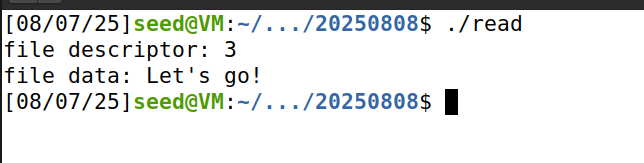
이번에는 지난번에 생성한 data*.txt파일 들을 read함수를 이용해서 읽어 들인다.
#include <stdio.h>
#include <stdlib.h>
#include <fcntl.h>
#include <unistd.h>

#define BUF_SIZE 100
void error_handling(char * message);

int main(void)
{
	int fd;
	char buf[BUF_SIZE];

	fd = open("data2.txt" , O_RDONLY);
	if(fd == -1)
		error_handling("open() error!");
	printf("file descriptor: %d \n", fd);

	if(read(fd, buf, sizeof(buf)) == -1)
		error_handling("read() error!");
	printf("file data: %s", buf);
	close(fd);
	return 0;
}


void error_handling(char* message)
{
	fputs(message, stderr);
	fputc('\n', stderr);
	exit(1);
}
다음과 같은 코드를 사용하여 파일에 적힌 내용을 출력할 수 있었다.
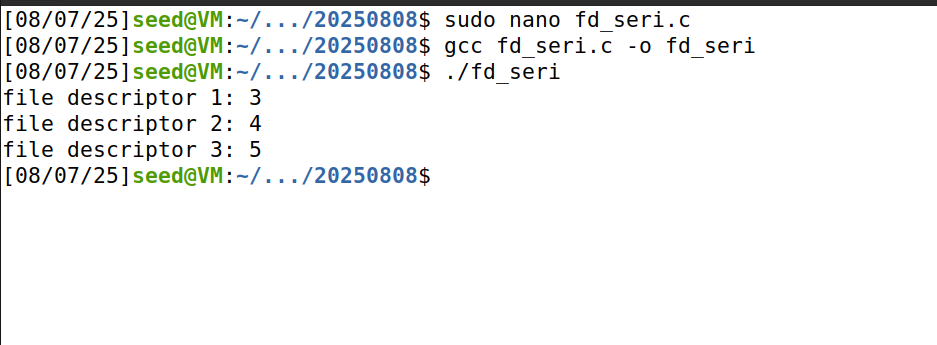
#include <stdio.h>
#include <fcntl.h>
#include <unistd.h>
#include <sys/socket.h>

int main(void)
{
	int fd1, fd2, fd3;
	fd1 = socket(PF_INET, SOCK_STREAM, 0);
	fd2 = open("test.dat", O_CREAT|O_WRONLY|O_TRUNC);
	fd3 = socket(PF_INET, SOCK_DGRAM, 0);


	printf("file descriptor 1: %d\n", fd1);
	printf("file descriptor 2: %d\n", fd2);
	printf("file descriptor 3: %d\n", fd3);

	close(fd1); close(fd2); close(fd3);
	return 0;
}
WORD 는 unsigned short로 정의되어 있음